
Category: History

Rapier Accessories

By François Henri Guyon
Originally published in Punta Dritta July AS XL (2005)

Sword

For much of the middle ages it was uncommon for people to wear swords as part of everyday dress. A knight would wear his sword on ceremonial occasions, and travellers would wear swords on journeys, but most people in England and France would carry only their belt knife.

In the early part of the Renaissance period, it became common for a gentleman to wear his sword at all times and in all places. Generally, this coincided with the decline of the land-owning class and the dramatic impact of plague on the population.

Initially, the sword was the same as used on the battlefield: broad bladed and cross hilted (Fig 1). Such a sword could hang from a person’s belt with little problem.
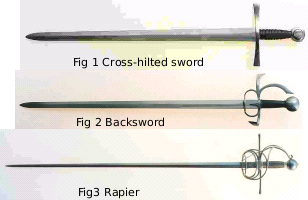
Figures 1-3 – Sword shapes: cross-hilted, backsword and rapier

As time progressed, however, the hilt of the sword became more complex to protect the hand and the blade became longer in an attempt to outreach the opponent. Some rapier blades reached between 48 and 60 inches in the length, making the simple act of drawing the sword difficult and dangerous.

George Silver, a conservative anti-rapier voice of the late 16th Century, writes that the normal length of a blade should be between a yard and one inch for the shortest man, to a yard and four or five inches for the tallest. We can assume, therefore, that rapiers commonly being used in London at the end of the century were longer than this.

In order to wear such a long rapier, it becomes necessary to angle the blade hanging from the belt, to prevent it dragging along the ground. There were three common devices used to accomplish this: Slings, Hanger and Baldric.

Belt and slings
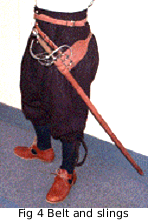
Figure 4 – Belt & slings

The Belt and Slings (Figure 4) is a simple affair. Two or three slides grip the scabbard of the sword. A strap (called a sidepiece) connects from the slings to the belt on the opposite side of the body, and is adjustable to control the angle of the sword.

Whilst this will keep the sword from the ground, the narrow range of the attachments will allow the sword to flap around a bit. It is not unknown for the slings to have a second strap around the leg to give more stability.

Hanger
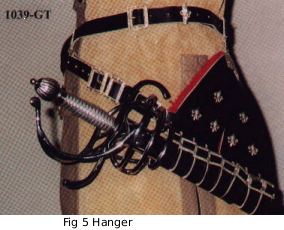
Figure 5 – Hanger

An adaptation of the Belt and Slings is the Hanger (Figure 5). This increases the number of slides and supports them with a broad panel of leather. This tends to be much more controllable and stable.

Both the Hanger and the Belt and Slings can be attached to a girdle or normal belt through the use of frogs, or friction loops, on the belt.

Baldric
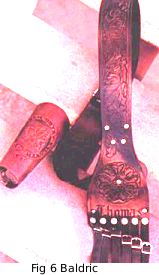
Figure 6 – Baldric

The final way of carrying a sword is the baldric (Figure 6). This is a simple belt, worn over the shoulder and sloping down to the opposite hip. The sword is attached by use of slides. There is, however, no easy way to wear a dagger on the baldric and so it is often seen as a military fashion or a very late period fashion.

Bowing

All these ways of carrying a sword require the rapier to trail a long way behind the body. When bowing from the waist, this causes the end of the sword to tip up (usually into somebody else). This could be a cause of a duel, so great care was taken to control thei sword when moving around. However, it is quite threatening to grip the rapier constantly by the handle, and this could also get the wearer into trouble.

For a right-handed fencer, the key is to use the inside and outside of the left hand to guide the rapier in the movement. Bowing is altered to the form of Reverenza used in Renaissance dance. The drawing back of the left foot allows the wearer to push the hilt wide of the body at the same time as extending the arms in the bow. This movement pushes the tip of the sword close behind the left ankle and thus out of the way.

Cape

The fashionable style for a cape was to wear it over the left shoulder. This leaves the sword arm free, whilst still affording some warmth and allowing the embroidery to be displayed.

If the cape was fastened with ties or buttons, they would run to the right armpit, tying diagonally across the chest. This leaves the left arm free to grasp the knife, affixed to the back of the belt, whilst the right arm is able to reach overhand. An Alta guard is almost impossible to achieve if the cape is tied over the right shoulder.

Hat

Surprisingly enough, most people in medieval and Renaissance Europe wore hats. I say surprisingly, because it is uncommon to see people in the SCA wearing them.

A fashionable Renaissance gentleman would feel just as undressed going out without a hat, as without his sword. Given the cold snap that covered Europe during the 16th century (which froze over the River Thames at times), it was very rare to see somebody without a hat.

During the bow, the hat is tipped or removed entirely, depending on the rank of the person you are being presented to: a touch of the brim or tug on the flat cap for a common acquaintance; complete removal for a lady or ranked person.

This is difficult to coordinate with sword and cape, especially on the dance floor, without disembowelling somebody behind you. A soft cap is gripped by the brim and replaced from the back of the head forward. This allows the drape of a soft cap to catch the back of the head. A solid hat is opposite, where the hat is gripped by the front of the brim and replaced on the temple and slid back into place.

Images taken from www.armor.com and www.imperialweapons.com

Sir, Your Sword’s Too Long!

By Francois Henry Guyon
Originally published in Punta Dritta January AS XXXV (2001)

My father sent me a clipping from the paper the other day. Entitled “Cut down to size” [1]; it details some rapier demonstrations at the Royal Armouries in Leeds, England. It is a short six-paragraph article, which talks about Queen Elizabeth the first’s decree on sword length. It claims that weapons were checked at the gates of the city of London and those exceeding a yard in length were broken. Hence (it says) the meaning of the phrase “Cut down to size”.

Great story, great article. It’s no wonder dad snipped it out and posted it to me. Pity that it is wrong.

When I started doing rapier in the SCA back in 1988, I was taught this same story about sword length. I may have been guilty of spreading it about myself. However, in researching hilt forms for illustrations in my earliest manual on sword construction I found that a number of swords depicted in books had blades that were longer than a yard, and longer by a lot. I decided to check out this ruling on blade length.

The great thing about bureaucracies is that they hate to throw anything away. Unless they are trying to hide something, that is. By doing a bit of catalogue searching at the Australian National Library (telnet://ilms.nla.gov.au/), I found a collection of proclamations made by the rulers of England from Henry VIII to Elizabeth I.

Tudor Royal Proclamations (3 Volumes). Edited by Paul L Hughes and James F Larkin. Yale University Press, New-Haven and London, 1969. (ABNRID 63013965 //r97).

A “quick” scan through volume 2 (“The Later Tudors”) gives the proclamation on page 278: 542. Enforcing Statues of Apparel [Greenwich, 12 February 1566, 8 Elizabeth I]. This is followed by a paragraph giving the details of the writ and its distribution and the costs of that distribution. Four Pounds, six Shillings, four pence was paid to the printers on 12 October to pay for 700 copies of the proclamation. It appears that it cost three pence to set up the type for the print on the 13th of February.

The first part concerns itself with pointing out how naughty people had become. The language used in the first paragraph makes it seem that these “Excesses of Apparel” were destroying the kingdom. The second paragraph lets people know that there will be no exceptions to the law.

The proclamation now divides itself into three further parts. The first is a re-issuing of certain clauses from a similar proclamation made in the 24th year of Henry VIII. The second is a re-issuing of a proclamation from the time of King Phillip and Queen Mary. Both of these parts concern themselves with the richness and make of people’s clothing.

The third part contains the new laws made by Elizabeth. In summary, these are;

Regulations on the making of hose,
Regulation of Fencing schools,
Regulation of blade lengths, and
Directions for enforcing the regulations.

The second and third items are of most interest to us. The details are contained in two long paragraphs making up less than a page of detail. The previous regulations take up over three pages.

Item, because it is daily seen what disorders do grow and are likely to increase in the realm by the increase of numbers of persons taking upon them to teach the multitude of the common people to play at all kind of weapons, and for that purpose set up schools, called schools of fence, in places inconvenient, tending to the great disorder of such people as properly ought to apply their labors and handiworks: therefore her majesty ordereth and commandeth that no teacher of fence shall keep any school or common place of resort in any place of the realm but within the liberties of some of the cities of the realm; where also they shall be obedient to such orders as the governors of the cities shall appoint to them for the better keeping of the peace, and for prohibition of resort of such people to the same schools as are not meet for that purpose, upon pain to be punished by the said governors according to their discretions.

My goodness, it’s a zoning law!

Item, her majesty also ordereth and commandeth that no person shall wear any sword, rapier, or suchlike weapon that shall pass the length of one yard and half-a-quarter of the blade at the uttermost, nor any dagger above the length of 12 inches in blade at the most, nor any buckler with any point or pike above two inches in length. And if any cutler or other artifices shall sell, make, or keep in his house any sword, rapier, dagger, buckler, or suchlike contrary thereunto, the same to be imprisoned and to make fine at the Queen’s majesty’s pleasure, and the weapon to be forfeited; and if any such person shall offend a second time, then the same to be vanished from the place and town of his dwelling.

It is interesting that the term rapier is well known enough to be used in a royal proclamation published in 1566 in England. There is, still, some controversy about the origin of the word, and when and where it was used. The English Guild “Maisters of the Noble Science of Defence” were not teaching the rapier as a standard part of their cirriculum at this stage. Senior Rocco Bonneti would not arrive in London for another three years. Yet the term appears popular enough to appear unqualified in a royal proclamation.

The length of a sword was limited to “one yard and half-a-quarter of the blade”. Without knowing specifically how this term was meant to be interpreted by Elizabeth’s Magistrates and Officers, we can not be sure how long this is. The use of the word ‘and’ indicates that it was over one yard by something called ‘half-a-quarter’. My interpretation is that it meant an additional half-a-quarter yard. This gives us a blade length of 1, 1/8 yards, or 40.5 Inches.

Daggers are limited to 12 inches in the blade. Which is still a considerably fearsome dagger. I would presume that this large length takes into account specialised knives and daggers used for special professions. A good cook’s knife of the period approaches that length. Much bigger than this length gives the weapon the qualities of a seax (or falchion) – a rather lethal weapon that authorities might not want people carrying around all the time.

Points on bucklers are apparently so common that they are regulated to a maximum length. The Wallace collection in London has some beautiful examples of such bucklers which have points of this or greater length. They generally seem to be a barbed pike head with a four-sided point. Such a point opens a nasty wound in the body, which does not naturally close again (similar to the French 3 sided bayonets of world war one). As recreators of the ancient art of Rapier fighting, we should be seriously looking at ways to allow buckler clashes and strikes.

The final parts are concerned with the enforcement of the proclamation items. Hosiers, being seen as pernicious offendors, are required to put up a bond in order to continue trading. In effect, I suspect, this became a matter of a fine before the event. Cutlers, Haberdashers, and Fencing Masters were not required to be bound in monies.

As has been noted by Turner and Soper [2], the length of a rapier was held to give definite advantage. There are cases cited of people seeking to purchase longer weapons before a duel in order to gain advantage over their opponent. It would seem that one effect of this proclamation would be to curb this activity (although I cannot see people organising duels for the middle of London city…). It could also be seen as a way of the monarch making a strong stand on matters that might be seen to be anti-English. Certainly when viewing this proclamation in concert with George Silver’s comments in Paradoxes, I suggest that conservative members of early Elizabethan society would regard the shorter cut & thrust sword with favour, and the longer Tucks as “Un-English”.

This proclamation appears to be the only one made by Elizabeth on weapons length. There are a full volume and a half collection of proclamations that she made on other matters (price of bread, wages, and so forth). It was also made early on in her career as Queen. Both of these points speak for the “Strong and Decisive Queen taking a strong stand” reason for weapons portion of the proclamation. Certainly other sources on Elizabeth’s life indicate that she was eager to consolidate her position on the throne, and to be seen as every bit the ruler that her father, Henry VIII, was.

In any case, Proclamation 542 being duplicated for you here, I hope to hear the last of these rumours about thirty-six inch blade lengths for Elizabethan swords. [3]

Francois Henri Guyon.

Footnotes:

1: Sunday Mail (Queensland, Australia), July 5, 1998. “Cut down to size”, by Warren Nunn

2: “Methods and Practice of Elizabethan Swordplay” by Craig Turner, Tony Soper, Joseph Papp (Designer), Southern Illinois Univ Pr (Trd); ISBN: 0809315629

3: ROTFLMAO

(c) Shayne Lynch 1999