Category: Articles

The Secret Blow

by François Henri Guyon
Originally published in Punta Dritta June/July AS XXXVI (2001)

The secret blow has always been a part of the teaching of Civilian Combat. Certain blows used at the correct time that are unable to be parried, or parries that will destroy any attack. Men who purported to know such blows were treated as wizards of the secret science of fence.

Saviolo, in talking to Luke in this treatise, describes a stance and ward that a untrained combatant, unexpectedly in a duel, is best to set themselves in. Castle talks about masters having special parries and attacks reserved for their special students. Certainly renaissance thinking about sword-fighting was that it was a skill and, therefore, a perfectible activity. It is quite possible that people obtained copies of Saviolo’s book to find information of the universal attack and parry.

I haven’t found a universal parry yet, since even the windscreen washer parry has some limitations (i.e. it doesn’t work). However I do seem to have found an attack that catches people quite often: a straight thrust immediately from the lay-on. Dameon Greybeard and I have been teaching this to our students over the past year with impressive results.

Even people fighting for many years treat our novices with respect, and nobody considers our students an easy fight.

In social terms, too, a straight thrust has much to recommend it. A person who gives promises sparingly and with thought, who speaks the truth without dissembling, who carries though on their intentions, is often admired simply for that. Modern language even has a phase for such people – a straight shooter.

I have heard tales of people who show open distain for fencers, threaten them, even spit at them. It is unfortunate, crude and horrible, and it is not the SCA and as such we should ignore it as much as we can. The core SCA concept is one of respect, courtesy, dignity, chivalry, and the sort of polite behaviour that seems to be impossible to find in the real world. Such people are really poisoning their own SCA experience – we should try to prevent them from poisoning ours.

Let us, instead, be upright fencers – straight thrusters who delight in period arts and sciences, including fencing, and are often found working hard to support their Kingdom, be that as marshals, constables, chirurgeons, seneschals, or just the people who stay late to help clean up at the feast.

Francois Henri Guyon
Lord Guildmaster of Fence

An Interesting Experiment in Draw Cuts

By Fergus MacTighearnain
Originally published in Punta Dritta June / July AS XXXVI (2001)

Greetings everyone,

I would like to share with everyone the results of the cutting test I performed at Valhalla this weekend. The test cutting subject was a 40 lbs. room temperature pork hind quarter, which was then covered with one (1) layer of 100% cotton and two (2) layers of natural fiber brocade.
 
The blade used was a sharpened 42″ Del Tin rapier blade.
 
The first attack were tip cuts delivered from both mandritto tondo and reverso tondo. Attacks with brocade on the subject resulted in very little damage, no wounds at all. I then removed the brocade and left the cotton in place, then applied the same tip cuts. This time on the first cut, I cut through a 5/8″ diameter bone with a small cut following. The next cut I delivered to the reverse side resulted in a deep laceration approximately 9″ long and 2″ deep. This wound if delivered to the abdomen would have easily killed an opponent stopping a fight. At this time I decided that tip cuts on the bare flesh were not necessary.
 
The next attacks were to be push/draw cuts, I reapplied the layers of material and applied a push cut. The first thing I found was that the tip has a tendency to catch in the material and deliver a puncture wound just below the skin. A draw cut had no effect what so ever on the material. I then removed the 2 layers of brocade, and proceeded again with the push/draw cuts. These had the same effects as before, I then removed all layers of cloth and applied a push/draw cut. To simulate skin I used plastic wrap as I felt that pig skin is to thick to accurately represent human skin. Both cuts resulted in cutting the skin and delivering an 1/8″ wound. In my opinion these are ineffective cuts and are a wasted effort.
 
Percussion cuts were next, these were delivered with a slicing motion from the shoulder. After several tries the only effect was pushing the cloth approx. 1/2″ into the meat. I then removed the brocade and proceeded with several more cuts, the results were the same, only the material was pushed into the meat 3/4″. I removed all the material and applied a cut to the skin only. This stressed the skin to break and pushed apart the meat but did not cut. This attack is also ineffective.
 
The last attack with the rapier was the thrust. Thrusts needed only minimal pressure to completely penetrate the subject. In the case of hitting bone, the tip was deflected and continued on its course, still completely penetrating the subject.
 
The next sword that I used was a one hand arming sword. Again I applied the cloth to the subject, with a straight down cutting motion I was unable to cut through the material. I tried a cutting motion combined with a slicing motion, and still I was unable to cut through the material. It should be noted that the material was pushed 1″ into the subject. I then removed the brocade and repeated the process, and I received the same result. The only difference being the cotton was pushed in approx. 1 1/2″. I now removed all material, and repeated the same cutting motions. This time I was able to cleave almost completely through the subject. The 1 3/4″ diameter bone offered no resistance and was sheared completely through.
 
This completed my cutting test and led to a very tasty feast.
 
I will have pictures of this test on the net soon and will provide the site address when I have it up. Thanks for reading a rather lengthy post. This test was very educational for me and everyone that attended. I hope the results I have provided have dispelled any myths or reinforced any shaky facts that may be out there.
 
Yours In Service
Lord Fergus MacTighearnain
Provost Royal Guild of Fence Kingdom of the West
Cynagua Rapier Marshal

A Simple Design for The Fencing Cape

by David Falcone D’el Phoid

Originally published in Punta Dritta, March AS XXXV (2001)

Those of you who have read, or perhaps tried your hand at my last published project, the Simple fencing coif, will recognize much in this design for a cape. If anything, it is even simpler than the coif. The design is for a small cape that is not unlike the vestigial cape worn by gentlemen at the height of the era of the Rapier. As a garment it is not much, but it flows well in the off hand of a fencer. To be durable, I made mine from trigger cloth. Though just about any cloth of similar weight should work as well. Brocades would have a nice look to them.

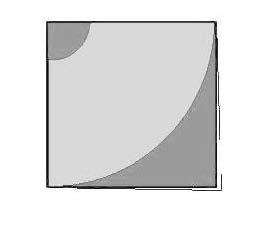
Start with a piece of cloth 60″x60″. Fold it top over bottom, and then again left over right. Tie a piece of string around a regular lead pencil. Hold on to the string with one hand at the upper left of the folded fabric, and inscribe an arc from the upper right to the lower left. Shorten the string to about 6″ and inscribe another arc. You should end up with something like this:

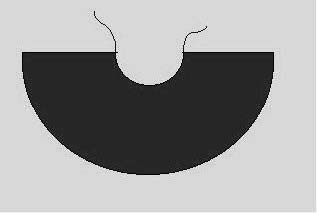
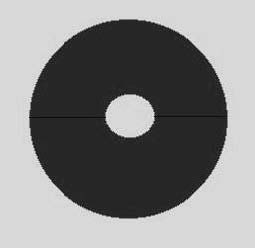
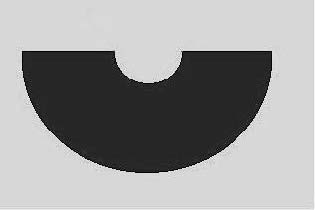
The color change is, of course, just to show the area that will be the cape more clearly. Cut the wasted cloth from the upper left and from the lower right. If you completely unfold the fabric you will have a doughnut shape like this.

Fold it top to bottom and sew the bottom edge.

This would be a good time to try the cape on, if you ever think to wear it. If the neck hole needs to be larger, re-cut it now. Then, reach through the neck hole, and pull the bottom seam through. This will leave the sewing on the inside of the cape to give the outside a more finished appearance. Sad to say, you now need to iron over the seam so that it will lay flat. It just will not look right if you don’t do that. The last step is to take a piece of bias tape in a matching or contrasting colour that is a good 20″ longer than the neck hole and centre it over the hole. Use it to sew the hole closed, finishing the edge and leaving the extra bias tape hang loose equally on each side to act as the tie string for the cape. That is all there is to it.

Making the Worlds Simplest SCA Legal Fencing Coif

by David Falcone D’el Phoid

Originally published in Punta Dritta Februaly AS XXXV (2001)

If you know how to sew, there are any number of coifs you can make. I don\’t know how to sew. But I figured, “Hay, how hard can it be?”. The answer is, not very… if you can get the machine to work. So I spent a bit of time trying to figure out how to get a machine to run a seam, and then designed a coif that used as few seams as possible. There are actually only 2 required.

The sewing part is quick enough that you could probably get someone to do that for you fairly easily. It should only take them about 4 min. Learn­ing to thread the bobbin took me about an hour……… The choice is yours.

Most coifs are designed to go under the fencing mask where it is pressed to your head. There is no possibility of any air movement. It gets hot where I am, so I designed a coif to go outside of the mask and to block ventilation as little as possible. This is an original design. You may feel free to make as many for personal or club use as you like (if you want to go into the business, we can talk). All I ask in return for my investment in time to design this, is that you make one from scrap or cheep material first so you know how it is done and don’t waste your chosen material. You can always donate the test piece to your Golden Key for cold weather, non fighting gear. You will end up with a good bit of odd shaped left over fabric. But as the total cost for this should be about $10, I was not too worried about thrift.

Materials:

  • 2 and 1/3 yards 60″ wide Trigger cloth in your choice of color
  • 1 package extra wide double fold bias tape in matching or contrasting color
  • 1 spool of matching thread.

The Process:
You are supposed to wash your cloth first. That way it will not shrink smaller than you want it to be. So cut your cloth into two pieces at least 40″ long by 60″ (the width of the cloth) and wash and dry it.

Take one piece and lay it out so the 38″ is left to right and the 60″ is top to
bottom. Fold it once bottom over top. Fold it again left over right. Now
you have 4 layers of cloth. Take a piece of string or even a piece of thread,
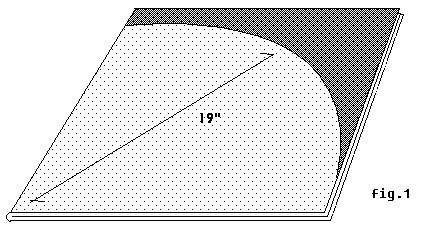
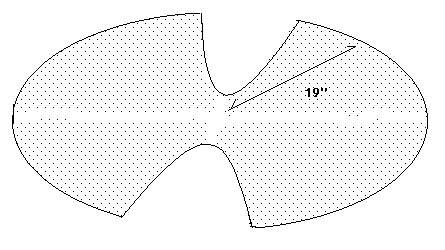
and tie it around a pencil. Measure the string to be 19″ long. Hold one end
of the string in the lower left corner of the cloth and draw an arc 19″ in ra-
dius as shown. Cut off out side the line.

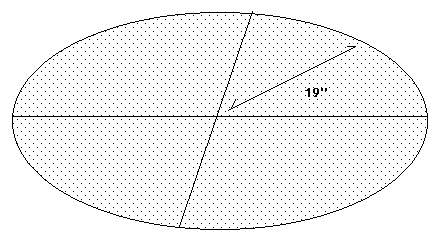
If you were to unfold the fabric you will have a circle with a 19″ radius (but don\’t unfold it)

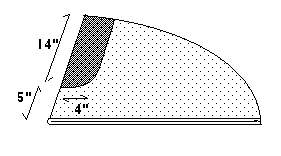
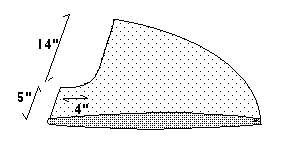
Now, on the left side of the material, draw a vertical line 4″ from the left. Draw another line across 5″ up from the bottom. Freehand, draw a connecting ark between the lines.

Cutting through all 4 layers of cloth, cut out the cloth shown shaded in the picture. Save these pieces. You can sew it into a nice belt pouch when you are done. You get two pouches as a bonus from this project. *S*

Repeat theses steps again so you have two identical pieces that look like……

Lay one on top of the other. Fold bottom over top, and left over right so it looks like…..

You will note that what will be the bottom is already a finished edge (as it is folded), and the chin is done as it is not cut. At this point you can take it to someone who can sew to run a seam over the back of the head (upper right of cloth). Now turn it inside out (which will make it right side out) and check the fit to your mask (if you did your own sewing, you may need to trim the fabric closer to the seam to avoid a wad of fabric…). Insert your mask into the hood and check for fit. The “chin” of the coif should fit over the bib of the mask, under the mask. The wire mesh of the mask should extend through the opening, but be fairly tight. You may have to enlarge the face opening a bit. Once that is right, sew on (or have sewn) the bias tape to finish the face opening. That’s all there is to it. If you are doing your own sewing, give this one to your local practice for loaner gear, and make yourself another one, you know, with out that mistake you made in the first one *grin*

Oh, and if your kingdom requires a separate strap to hold the bottom of the mask to your head, take a luggage strap, small belt, or some of that left over bias tape, and sew it to the inside of the chin of the coif. As this will go over the bib of your mask, when you fasten or tie it around behind your head, your mask is secured as per the rules.

Sir, Your Sword’s Too Long!

By Francois Henry Guyon
Originally published in Punta Dritta January AS XXXV (2001)

My father sent me a clipping from the paper the other day. Entitled “Cut down to size” [1]; it details some rapier demonstrations at the Royal Armouries in Leeds, England. It is a short six-paragraph article, which talks about Queen Elizabeth the first’s decree on sword length. It claims that weapons were checked at the gates of the city of London and those exceeding a yard in length were broken. Hence (it says) the meaning of the phrase “Cut down to size”.

Great story, great article. It’s no wonder dad snipped it out and posted it to me. Pity that it is wrong.

When I started doing rapier in the SCA back in 1988, I was taught this same story about sword length. I may have been guilty of spreading it about myself. However, in researching hilt forms for illustrations in my earliest manual on sword construction I found that a number of swords depicted in books had blades that were longer than a yard, and longer by a lot. I decided to check out this ruling on blade length.

The great thing about bureaucracies is that they hate to throw anything away. Unless they are trying to hide something, that is. By doing a bit of catalogue searching at the Australian National Library (telnet://ilms.nla.gov.au/), I found a collection of proclamations made by the rulers of England from Henry VIII to Elizabeth I.

Tudor Royal Proclamations (3 Volumes). Edited by Paul L Hughes and James F Larkin. Yale University Press, New-Haven and London, 1969. (ABNRID 63013965 //r97).

A “quick” scan through volume 2 (“The Later Tudors”) gives the proclamation on page 278: 542. Enforcing Statues of Apparel [Greenwich, 12 February 1566, 8 Elizabeth I]. This is followed by a paragraph giving the details of the writ and its distribution and the costs of that distribution. Four Pounds, six Shillings, four pence was paid to the printers on 12 October to pay for 700 copies of the proclamation. It appears that it cost three pence to set up the type for the print on the 13th of February.

The first part concerns itself with pointing out how naughty people had become. The language used in the first paragraph makes it seem that these “Excesses of Apparel” were destroying the kingdom. The second paragraph lets people know that there will be no exceptions to the law.

The proclamation now divides itself into three further parts. The first is a re-issuing of certain clauses from a similar proclamation made in the 24th year of Henry VIII. The second is a re-issuing of a proclamation from the time of King Phillip and Queen Mary. Both of these parts concern themselves with the richness and make of people’s clothing.

The third part contains the new laws made by Elizabeth. In summary, these are;

Regulations on the making of hose,
Regulation of Fencing schools,
Regulation of blade lengths, and
Directions for enforcing the regulations.

The second and third items are of most interest to us. The details are contained in two long paragraphs making up less than a page of detail. The previous regulations take up over three pages.

Item, because it is daily seen what disorders do grow and are likely to increase in the realm by the increase of numbers of persons taking upon them to teach the multitude of the common people to play at all kind of weapons, and for that purpose set up schools, called schools of fence, in places inconvenient, tending to the great disorder of such people as properly ought to apply their labors and handiworks: therefore her majesty ordereth and commandeth that no teacher of fence shall keep any school or common place of resort in any place of the realm but within the liberties of some of the cities of the realm; where also they shall be obedient to such orders as the governors of the cities shall appoint to them for the better keeping of the peace, and for prohibition of resort of such people to the same schools as are not meet for that purpose, upon pain to be punished by the said governors according to their discretions.

My goodness, it’s a zoning law!

Item, her majesty also ordereth and commandeth that no person shall wear any sword, rapier, or suchlike weapon that shall pass the length of one yard and half-a-quarter of the blade at the uttermost, nor any dagger above the length of 12 inches in blade at the most, nor any buckler with any point or pike above two inches in length. And if any cutler or other artifices shall sell, make, or keep in his house any sword, rapier, dagger, buckler, or suchlike contrary thereunto, the same to be imprisoned and to make fine at the Queen’s majesty’s pleasure, and the weapon to be forfeited; and if any such person shall offend a second time, then the same to be vanished from the place and town of his dwelling.

It is interesting that the term rapier is well known enough to be used in a royal proclamation published in 1566 in England. There is, still, some controversy about the origin of the word, and when and where it was used. The English Guild “Maisters of the Noble Science of Defence” were not teaching the rapier as a standard part of their cirriculum at this stage. Senior Rocco Bonneti would not arrive in London for another three years. Yet the term appears popular enough to appear unqualified in a royal proclamation.

The length of a sword was limited to “one yard and half-a-quarter of the blade”. Without knowing specifically how this term was meant to be interpreted by Elizabeth’s Magistrates and Officers, we can not be sure how long this is. The use of the word ‘and’ indicates that it was over one yard by something called ‘half-a-quarter’. My interpretation is that it meant an additional half-a-quarter yard. This gives us a blade length of 1, 1/8 yards, or 40.5 Inches.

Daggers are limited to 12 inches in the blade. Which is still a considerably fearsome dagger. I would presume that this large length takes into account specialised knives and daggers used for special professions. A good cook’s knife of the period approaches that length. Much bigger than this length gives the weapon the qualities of a seax (or falchion) – a rather lethal weapon that authorities might not want people carrying around all the time.

Points on bucklers are apparently so common that they are regulated to a maximum length. The Wallace collection in London has some beautiful examples of such bucklers which have points of this or greater length. They generally seem to be a barbed pike head with a four-sided point. Such a point opens a nasty wound in the body, which does not naturally close again (similar to the French 3 sided bayonets of world war one). As recreators of the ancient art of Rapier fighting, we should be seriously looking at ways to allow buckler clashes and strikes.

The final parts are concerned with the enforcement of the proclamation items. Hosiers, being seen as pernicious offendors, are required to put up a bond in order to continue trading. In effect, I suspect, this became a matter of a fine before the event. Cutlers, Haberdashers, and Fencing Masters were not required to be bound in monies.

As has been noted by Turner and Soper [2], the length of a rapier was held to give definite advantage. There are cases cited of people seeking to purchase longer weapons before a duel in order to gain advantage over their opponent. It would seem that one effect of this proclamation would be to curb this activity (although I cannot see people organising duels for the middle of London city…). It could also be seen as a way of the monarch making a strong stand on matters that might be seen to be anti-English. Certainly when viewing this proclamation in concert with George Silver’s comments in Paradoxes, I suggest that conservative members of early Elizabethan society would regard the shorter cut & thrust sword with favour, and the longer Tucks as “Un-English”.

This proclamation appears to be the only one made by Elizabeth on weapons length. There are a full volume and a half collection of proclamations that she made on other matters (price of bread, wages, and so forth). It was also made early on in her career as Queen. Both of these points speak for the “Strong and Decisive Queen taking a strong stand” reason for weapons portion of the proclamation. Certainly other sources on Elizabeth’s life indicate that she was eager to consolidate her position on the throne, and to be seen as every bit the ruler that her father, Henry VIII, was.

In any case, Proclamation 542 being duplicated for you here, I hope to hear the last of these rumours about thirty-six inch blade lengths for Elizabethan swords. [3]

Francois Henri Guyon.

Footnotes:

1: Sunday Mail (Queensland, Australia), July 5, 1998. “Cut down to size”, by Warren Nunn

2: “Methods and Practice of Elizabethan Swordplay” by Craig Turner, Tony Soper, Joseph Papp (Designer), Southern Illinois Univ Pr (Trd); ISBN: 0809315629

3: ROTFLMAO

(c) Shayne Lynch 1999